
Reviewed · HISTORICAL TOURS
Walking tour in the Historic Center of Arequipa
Arequipa’s best introduction may be its simplest: a two-hour walk from the Plaza de Armas to alpaca country and back. This $10 tour links grand churches, old courtyards, volcano views, a camelid farm, and the city’s oldest neighborhood without putting you in a bus or behind a window.
I like the useful mix of major sights and small surprises, especially Mundo Alpaca, where you can see llamas, alpacas, suri, and vicuñas, and the walk to San Lazaro, the first settlement of the White City. I also like the guides’ local touch. Edgar, Johan, Beatriz, Francisco, and Jorge Echeandia have all been singled out for humor, history, food advice, and clear explanations.
The catch is the payment setup. You pay $10 to reserve, then give the guide a voluntary tip at the end. A practical expectation is 30 to 50 soles per person, which can make the final cost less bargain-like than the headline price. The pace can also feel quick, with limited time for photos.
In This Review
- Key points at a glance
- Starting one block from Arequipa’s main square
- Reading Arequipa through the Plaza de Armas
- The Compañía cloisters and old city courtyards
- El Puente Grau and the three volcanoes
- Mundo Alpaca and Arequipa’s camelid connection
- San Lazaro, the first settlement of the White City
- What the guides add to the experience
- The real price: $10 plus a guide tip
- Optional museum visits and extra entrance fees
- Who should book this Arequipa walk?
- Should you book it?
- FAQ
- How much does the Arequipa walking tour cost?
- How long does the tour last?
- Where does the tour meet?
- Where does the tour finish?
- What languages are available?
- Is the tour entirely on foot?
- Are entrance fees included?
- Can I cancel the booking?
Key points at a glance
- Mundo Alpaca adds an unusual city-tour stop: See and sometimes feed llamas and alpacas, along with suri and vicuñas.
- The Plaza de Armas gets real context: Learn how the arches, portals, churches, and central square fit into Arequipa’s story.
- El Puente Grau gives you volcano views: Look toward Misti, Chachani, and Pichu Pichu from a useful city viewpoint.
- San Lazaro shows an older, quieter side of Arequipa: Walk through the district linked with the city’s first settlement.
- The guides are a major part of the value: Edgar, Johan, Beatriz, Francisco, and Jorge Echeandia have been praised for wit, local facts, and practical recommendations.
- The low booking price is not the full cost: Add a voluntary guide tip, and pay separately if you enter Santa Catalina or another museum.
Starting one block from Arequipa’s main square
You meet at Santa Catalina Street 204, about one block from the Plaza de Armas. The guide carries an umbrella, making the meeting point easier to spot in the busy center.
That sounds minor, but it matters. The meeting point is not in the middle of the square, where groups and pedestrians can be hard to sort out. Still, arrive a little early and check the exact address. One recent outing had a delayed start when the guide was not immediately at the meeting place and the organizer did not answer the first call.
The tour runs in English or Spanish, and the listed duration is about two hours. Some walks have taken closer to two and a half hours, depending on the pace, questions, and stops. You walk the entire route, so wear shoes that can handle stone streets and bring water.
A few more Arequipa trips to weigh up
- Arequipa: Walk through the Historic Center of the City
★ 4.9 · 87 reviews - Arequipa, Historic and Colonial City and Santa Catalina Monastery
★ 4.5 · 42 reviews - Walking tour through the Historic Center of Arequipa
★ 4.0 · 3 reviews
Reading Arequipa through the Plaza de Armas
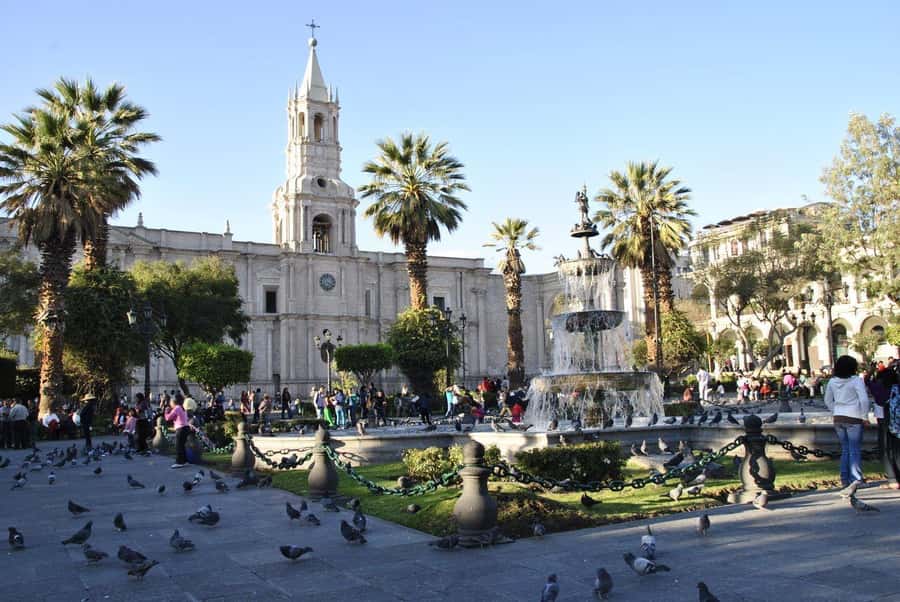
The Plaza de Armas is the right place to begin. Rather than simply taking a few photos and moving on, you get an explanation of the square’s traditional arches and the portals that frame it.
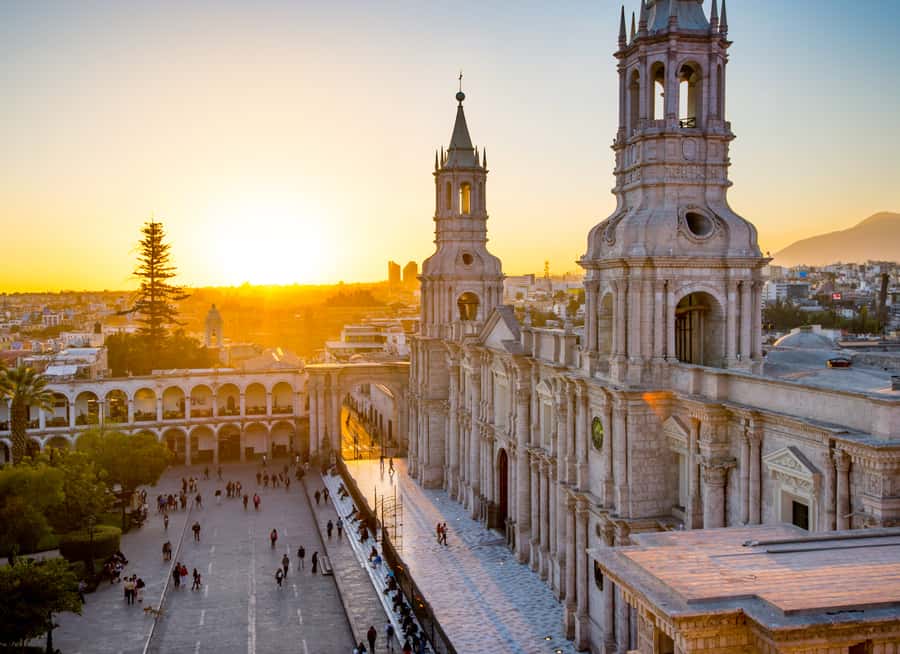
Arequipa is known as the White City, a reference to the pale volcanic stone used in much of its historic architecture. The square gives you an immediate sense of that style: formal arcades, carved facades, church architecture, and a broad open center that still functions as the city’s main meeting place.
I find this opening especially useful if you arrived in Arequipa the night before. It gives you a basic map of the center and helps you recognize the difference between a building that looks pretty and one that carries a particular religious, civic, or colonial role.
The guide also adds everyday observations. One tour pointed out the long line of people renewing national identity cards, a small modern scene that says as much about present-day Arequipa as an old facade says about the past. That kind of detail keeps the walk from becoming a string of dates and building names.
The Compañía cloisters and old city courtyards
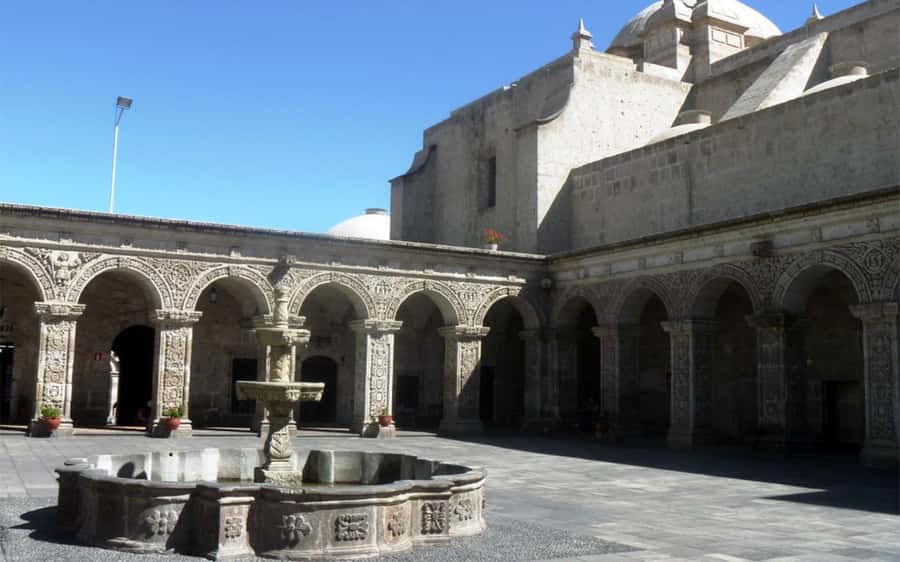
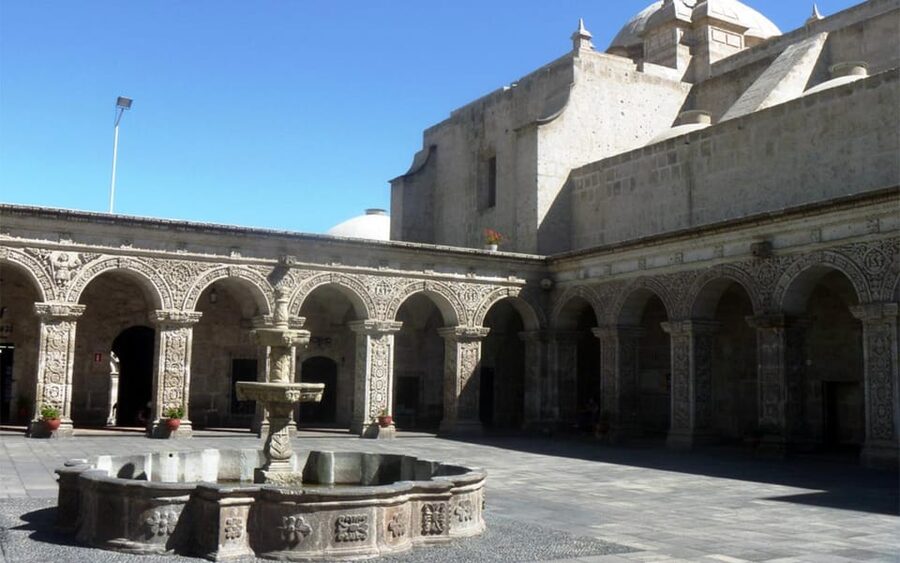
The next major stop is the cloisters of the Compañía, one of the city center’s most appealing pieces of architecture. Arches, carved stone, and inner courtyards reward a slower look, even if the overall walk keeps moving.
This is one place where a guide adds real value. Religious architecture in Arequipa is full of symbols, decorative details, and visual references that are easy to miss on your own. Beatriz, one of the guides mentioned by name, has explained the meaning behind religious art and architecture in a way that helps you read what you are seeing instead of treating it as background decoration.
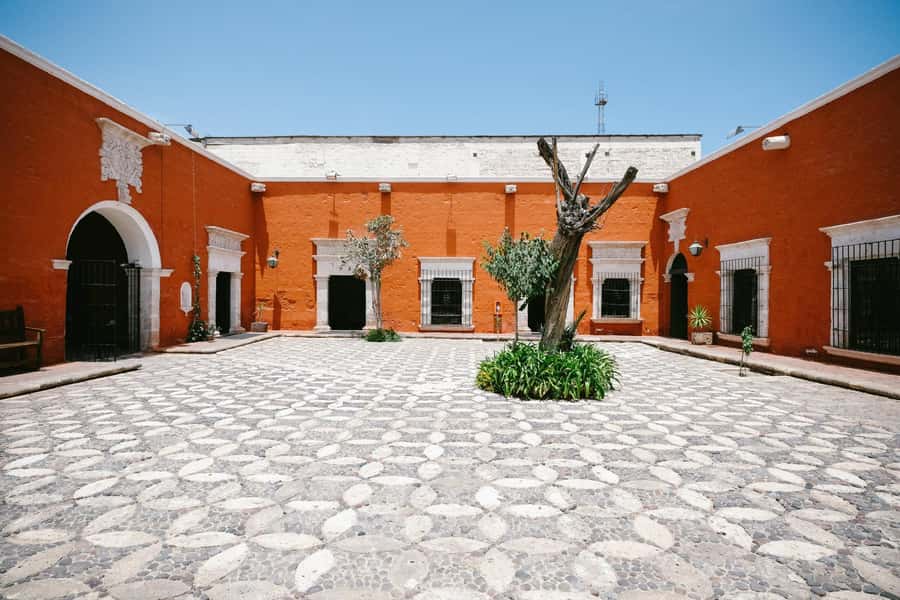
The route also passes old mansions and city gardens. These stops are less formal than a museum visit, but they help fill in the spaces between headline attractions. You may see charming courtyards, older residential buildings, and views that would be easy to miss while walking directly from one famous site to another.
There is a tradeoff. A two-hour tour covering this much ground cannot offer long photo stops at every courtyard. If you like to frame each doorway or take detailed architectural pictures, you may feel hurried. I would treat this walk as an introduction, then return later to the places that deserve more time.
El Puente Grau and the three volcanoes
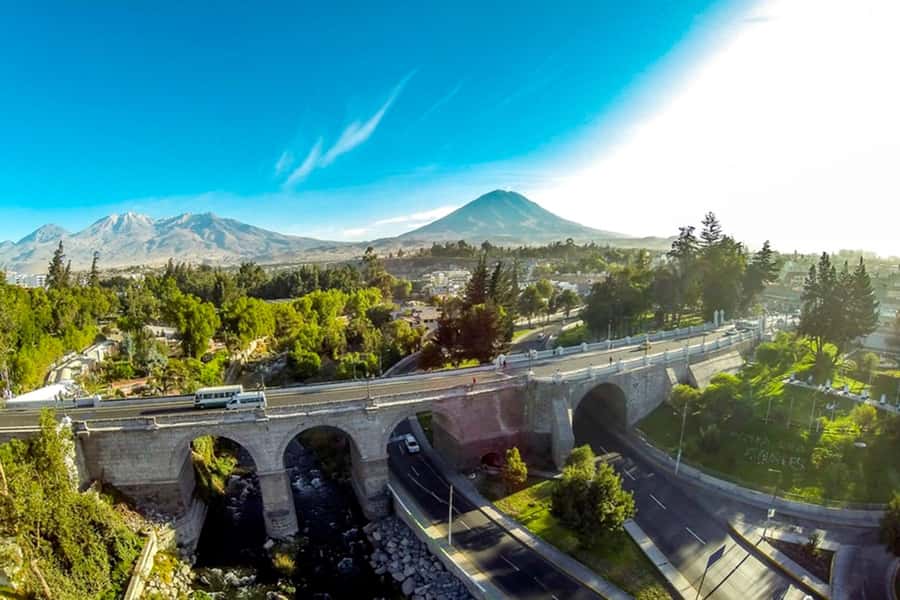
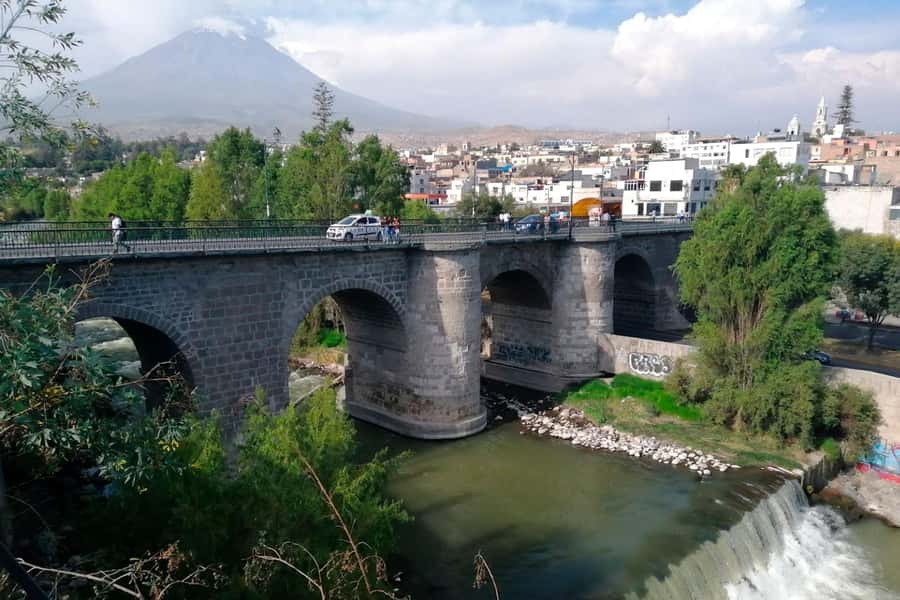
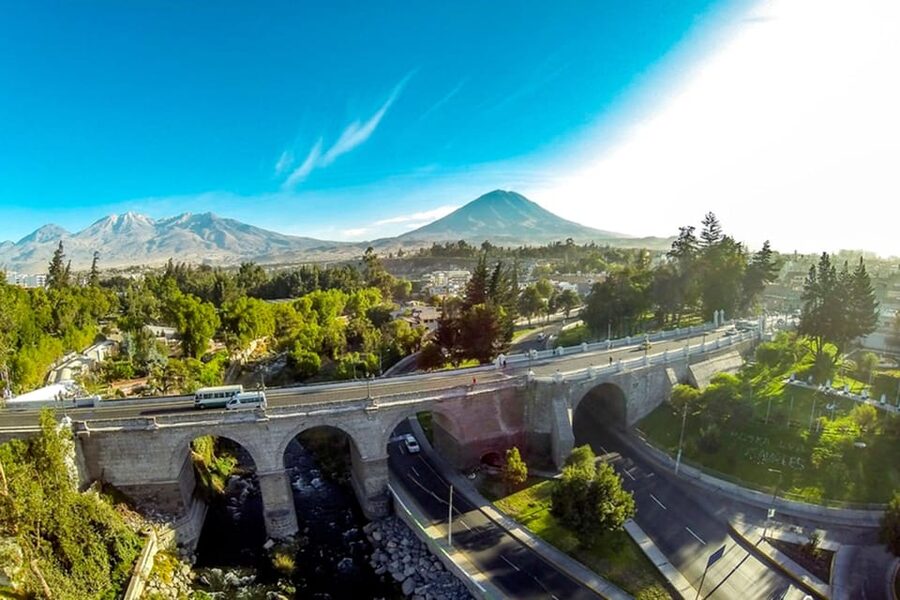
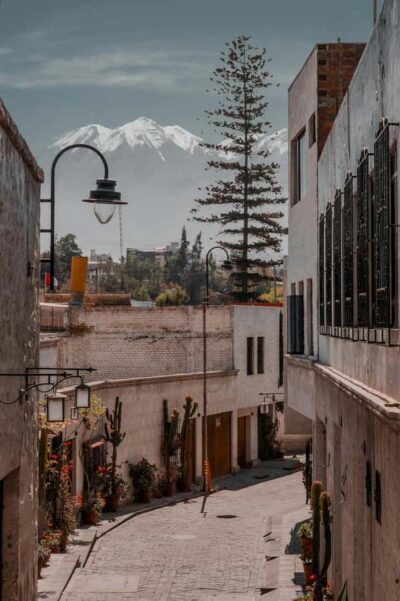
The route reaches a strategic viewpoint near El Puente Grau. From here, you may see Misti, Chachani, and Pichu Pichu, the volcanoes that shape Arequipa’s surroundings.
This is a good reminder that Arequipa is not just a historic center. The city’s identity is tied to its volcanic setting, and the pale stone buildings make more sense when you understand the local geology and the presence of the mountains beyond the streets.
The view depends on conditions, of course. Clear weather gives you the strongest payoff, while clouds can soften or block the volcanoes. Still, the stop adds scale to the walk. After looking closely at cloisters and carved portals, you get a wider sense of the city and its setting.
Bring your camera, but do not count on a long viewing session. The tour keeps moving, and the time available for photos may be brief. If the volcanoes are clear, I would make this one of your priority stops.
Same valley, a completely different kind of day:
- From Arequipa: Colca Canyon Full-Day Guided Tour with Meals
★ 4.5 · 982 reviews - Tour to the Salinas Lagoon and National Reserve in Arequipa
★ 4.5 · 548 reviews - From Arequipa: Sillar Route Trek
★ 4.2 · 461 reviews - Arequipa: Chili River White Water Rafting with Hotel Pickup
★ 4.8 · 329 reviews
Mundo Alpaca and Arequipa’s camelid connection
Mundo Alpaca is the tour’s most unexpected change of scene. Here you visit an older breeding area for camelids and see llamas, alpacas, suri, and vicuñas near the city center.
The stop works on two levels. First, it is simply fun. Feeding a llama or alpaca gives the walk a memorable, hands-on moment, and seeing young animals can be a highlight. Second, it connects Arequipa with the fibers and textiles that are important to the region.
You can optionally buy fabrics made from the same fibers. That makes this stop useful if you are considering an alpaca textile purchase, since you can first see the animals and learn about the materials. I would still treat the shopping as optional. You do not need to buy anything for the stop to be worthwhile.
The camelid area also gives families and younger visitors a reason to enjoy a tour that otherwise focuses heavily on architecture and history. One visitor specifically called seeing a baby llama and alpaca the high point of the walk. For many people, this will be the part they remember most clearly.
San Lazaro, the first settlement of the White City
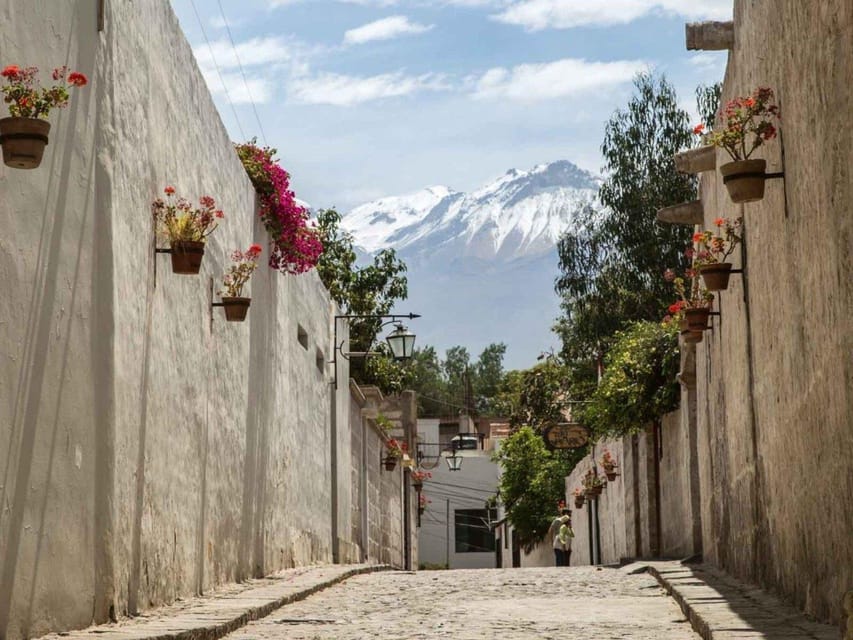
The final major neighborhood is San Lazaro, identified as the first town founded in Arequipa. Its importance is not just historical. The district gives you a different feel from the formal Plaza de Armas and its monumental buildings.
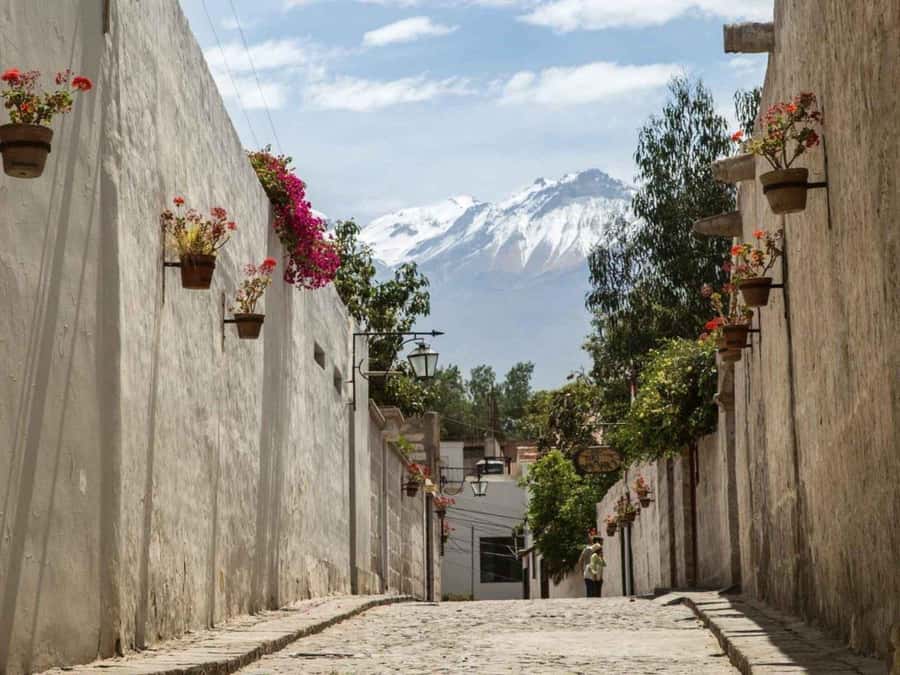
Walking through San Lazaro helps you see how Arequipa developed beyond its central square. The neighborhood adds smaller streets, older homes, and a more local scale to the day. It is a useful counterpoint to the grand portals and churches earlier in the route.
I like this part because it gives the city a sense of layers. The Plaza de Armas shows the official face of Arequipa. San Lazaro helps you picture the early settlement that came before the modern city spread outward.
The walk finishes back near Santa Catalina Street and the Plaza de Armas. That makes the tour easy to combine with lunch, a museum visit, or a second look at the square. It also leaves you in a central area rather than sending you to an inconvenient outlying stop.
What the guides add to the experience
The strongest part of this tour is often the person leading it. Guides named Edgar, Johan, Beatriz, Francisco, and Jorge Echeandia have been noted for clear explanations, humor, patience, and useful recommendations.
Edgar has been praised for making history entertaining and for pointing out practical modern details around town. Johan has been described as funny and engaging. Beatriz has explained religious art, Peruvian food, and Arequipa’s past, while Francisco has been appreciated for showing the city through a local’s eyes. Jorge Echeandia has been singled out for being friendly, helpful, and well prepared.
You should not assume you will receive one particular guide unless the operator confirms it. The names are useful because they show the style you can hope for: a tour built around conversation, questions, stories, and local suggestions rather than a memorized speech.
The guide may also recommend places to eat after the walk. That is particularly helpful in Arequipa, where a first-time visitor may want to try local food but not know which streets or restaurants to investigate. One guide also included small tastings such as cocktails and cheese helada, though these should not be treated as guaranteed parts of every departure because they are not listed among the standard inclusions.
The real price: $10 plus a guide tip
At first glance, $10 per person is an excellent price for a two-hour guided walk. You see several important parts of the center, get a local explanation, and visit a camelid attraction without arranging several separate stops.
The payment model needs a clear explanation. The $10 reservation charge covers your place, but the tour asks you to give a voluntary tip to the guide afterward. The stated reason is to help cover the guide’s service and maintenance payments connected with the places visited.
One practical account puts the expected tip at 30 to 50 soles per person. That is not the same as a fixed admission fee, but it can be a meaningful addition to the $10 booking price. I would budget for it before booking so the final amount does not surprise you.
The value remains good if you want a broad introduction and plan to listen closely. It is less compelling if you are looking for a fully prepaid tour with no social pressure around tipping. The tour has been rated 4.4 out of 5 from 180 reviews, and most of the strong praise focuses on the guides and the amount of ground covered.
Optional museum visits and extra entrance fees
The standard walk does not replace a full visit to Arequipa’s major museums and convents. If you want to enter Santa Catalina Convent or a museum such as the Juanita mummy museum, you can arrange that in advance, pay an extra entrance fee, and hire an internal guide.
This distinction matters. Santa Catalina deserves time because it is a major attraction in its own right, but adding it to a fast city walk could make the schedule feel crowded. I would use this tour to understand the center first, then visit Santa Catalina separately if your schedule allows.
The same applies to the Juanita mummy museum and other city museums. The walking tour can point you toward them, but entry fees and internal guiding are separate. Ask about the plan before the start if you want to add one.
Who should book this Arequipa walk?
I would choose this tour if you have just arrived in Arequipa and want to get your bearings quickly. It is also a good fit if you prefer walking, enjoy asking questions, and want a mixture of architecture, local stories, city views, and animals.
Families may appreciate Mundo Alpaca, while architecture fans will get the most from the Plaza de Armas, Compañía cloisters, mansions, gardens, and religious art. Food-minded visitors can also benefit from the local restaurant suggestions and, on some departures, small tastings.
You may want something else if you dislike group walks, need long pauses for photography, or prefer a fixed-price arrangement. The route covers a lot in two hours, and one account found it rushed at times. The tip system also requires a little planning.
Book at least 24 hours ahead if you want the listed free-cancellation protection. You can cancel up to 24 hours before the activity for a full refund, and the reserve-now, pay-later option keeps you from paying the booking charge immediately.
Should you book it?
Book this Arequipa historic center walking tour if you want a lively first look at the city for a modest upfront price. The combination of the Plaza de Armas, Compañía cloisters, volcano views, Mundo Alpaca, and San Lazaro is unusually broad for a two-hour walk.
Go in expecting a brisk introduction, not a leisurely museum tour. Bring water, allow for the voluntary tip, and confirm any extra museum visits in advance. If you do that, the tour offers a practical way to understand Arequipa’s architecture, setting, neighborhoods, and local character before exploring the city on your own.
FAQ
How much does the Arequipa walking tour cost?
The reservation price is $10 per person. You are also asked to give the guide a voluntary tip at the end, so budget for that additional payment.
How long does the tour last?
The listed duration is two hours. Some outings may take about two and a half hours depending on the pace and questions.
Where does the tour meet?
The meeting point is Santa Catalina Street 204, about one block from the Plaza de Armas. The guide will have an umbrella in hand.
Where does the tour finish?
The walk returns to Santa Catalina Street 204, near the Plaza de Armas.
What languages are available?
The tour is offered with a live guide in English or Spanish.
Is the tour entirely on foot?
Yes. The route is walked from the meeting point and returns to the center.
Are entrance fees included?
The tour information lists entrance to the places visited, but Santa Catalina Convent and museums such as the Juanita mummy museum are described as optional additions with separate entrance costs and internal guides. Confirm the exact plan before starting.
Can I cancel the booking?
You can cancel up to 24 hours in advance for a full refund. The reserve-now, pay-later option allows you to hold a place without paying immediately.
Just added around Arequipa
- Walking tour through the Historic Center of Arequipa★ 4.0 · 3 reviews
- Trek to the Route of the Sillar and Culebrillas in Arequipa★ 4.0 · 9 reviews
- 3-Day Colca Canyon trek with Professional Guide★ 5.0 · 40 reviews
- Trekking, Waterfalls and Thermal Baths★ 4.5 · 47 reviews
- Colca Full Day★ 5.0 · 57 reviews
- Full Day Tour to Colca Canyon from Arequipa★ 4.0 · 34 reviews
- Private 3 Day Colca Canyon Trekking tour (superior Service)★ 5.0 · 58 reviews
- 8-Hours Tour in Arequipa Laguna de Salinas with Pick-up★ 4.5 · 56 reviews
Historical Tours, compared.
Guided Tour of Historic and Monumental Trujillo
Read our review →
Lima’s Vibrant Heritage: Exploring the City’s Landmarks Half-day
Read our review →
Historic Center Street Food, Market, and Eateries Tour
Read our review →
Historic Downtown, Miraflores & Catacombs Private Tour
Read our review →
Machu Picchu Private Archaeological and Historical Guided Tour
Read our review →
Browse the lists this tour appears in