
Reviewed · TRUJILLO TOURS
Visit Trujillo Medieval Scene and Route of the Discoverers
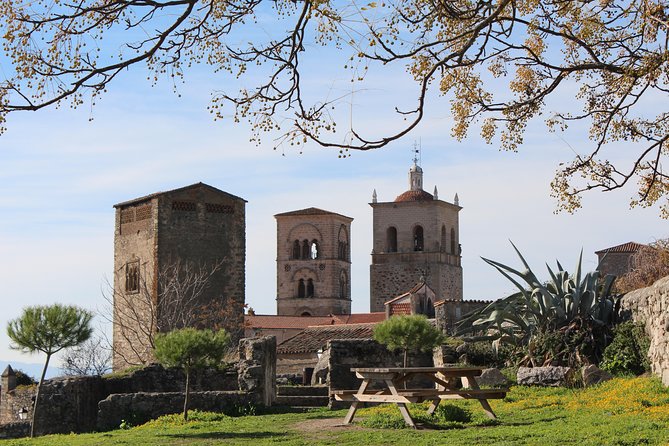
Trujillo’s appeal is easy to grasp once you reach its broad Plaza Mayor: stone palaces, church towers, and the hilltop castle turn the town into a real-life history set. This guided walk connects those sights to the men and women who shaped Trujillo, from medieval nobles to the conquistadors whose fortunes crossed the Atlantic.
I like the included daytime entries to the castle, cisterns, and Santa María la Mayor, since those are the places you most want explained rather than simply photographed. I also like the guides’ reported style: Alicia, Ana, José, and Esmeralda are praised for clear storytelling, local details, family histories, art, architecture, and even Extremadura’s biodiversity.
The main consideration is physical. You will walk through a medieval town with cobbled streets and uphill sections to the castle, and the advertised duration is approximate. The description says 2 hours 30 minutes, while the stop breakdown can read longer, so allow a relaxed morning rather than planning a tight connection afterward.
In This Review
- Key points to know before booking
- Why Trujillo works so well as a walking tour
- The castle and cisterns on Trujillo’s high ground
- Santa María la Mayor and the town’s religious history
- Palaces around Plaza Mayor
- Pizarro House Museum and the human side of the story
- San Martín and the open-air historic center
- The guide makes the difference
- Price, group size, and practical value
- Who will get the most from this Trujillo walk
- Should you book it?
- FAQ
- Where does the Trujillo guided tour start?
- What time does the tour begin?
- How long does the experience last?
- Is entry to Trujillo Castle included?
- Is Santa María la Mayor included?
- Is entry to San Martín included?
- How many people can join the tour?
- Can I cancel for a full refund?
Key points to know before booking
- The castle and cisterns are included during daytime visits, giving you access to Trujillo’s most dramatic historic stop.
- Santa María la Mayor is part of the guided visit, though monument access is not included for visits beginning after 8 p.m.
- The walk begins and ends in Plaza Mayor, also known as Plaza de la Hispanidad.
- The route links medieval and Renaissance Trujillo with the Isabel la Católica, Carlos V, and Discoverers themes.
- Guides such as Alicia, Ana, José, and Esmeralda are praised for lively explanations, not just lists of dates and names.
- The group can reach up to 35 people, so this is a shared walking tour rather than a private experience.
Why Trujillo works so well as a walking tour
Trujillo is compact, but its story is not. The town’s medieval core rises toward the castle, while the Plaza Mayor gathers grand Renaissance buildings connected to powerful families. You can see a church, palace, convent, tower, and manor house within a short walk, but the connections between them are what make a guide useful.
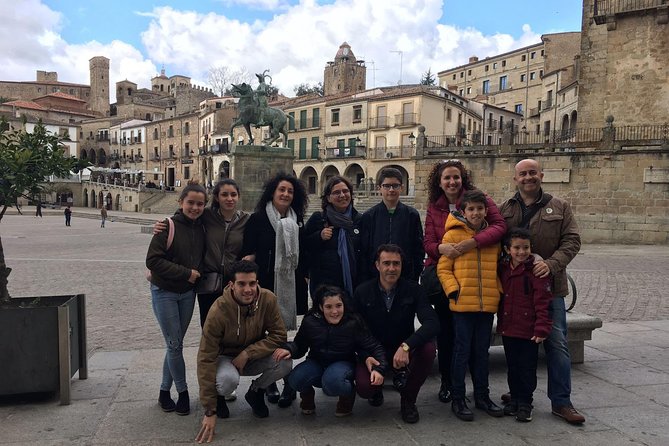
The route begins in Plaza Mayor at 10:30 a.m. That is a sensible starting point. The square gives you an instant view of Trujillo’s public face, with Renaissance palaces arranged around an open space and the equestrian statue of Francisco Pizarro at its center. The square is also called Plaza de la Hispanidad, a name that reflects Trujillo’s links with Spain’s American expansion.
I would use the first part of the walk to get your bearings. Look up at the coats of arms, balconies, stonework, and differing styles around the square. A guide can explain which families gained wealth and status, how the town’s noble houses were linked to overseas ventures, and why the architecture changes from medieval severity to Renaissance display.
That context matters. Without it, Trujillo can look like a collection of handsome facades. With it, the square becomes a record of ambition, family power, faith, and money.
Other Trujillo days worth putting on the list:
- Guided Tour of Historic and Monumental Trujillo
★ 5.0 · 930 reviews - Guided tour in Trujillo at Sunset “El Collector de Atardeceres”
★ 5.0 · 88 reviews - Full Day Tour Huacas, Chan Chan & Huanchaco – Trujillo
★ 4.5 · 64 reviews
The castle and cisterns on Trujillo’s high ground
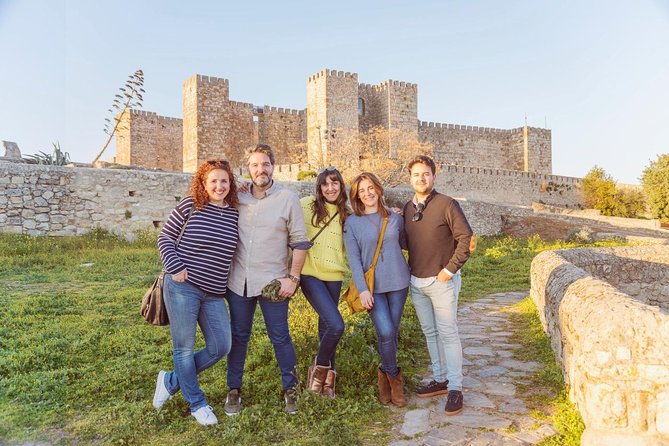
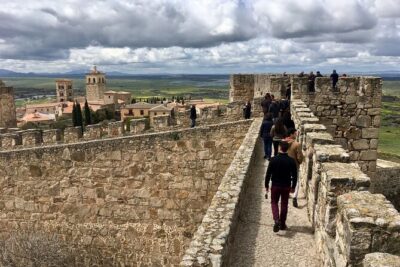
The walk continues into the medieval town and up toward the Castillo de Trujillo. The fortress, also called the Alcazaba, is one of the tour’s strongest physical highlights. Its position gives the visit a clear sense of place: this was a fortified settlement, not simply a pretty hill town.
The included visit covers the castle and its cisterns. The cisterns are especially useful because they show the practical side of medieval defense. A fortress needed stored water to survive a siege, and these underground structures bring that basic reality into focus better than another palace facade would.
The listed stop is only 15 minutes, but that should be read as a guide to the overall flow rather than a promise that every part of the castle receives a full independent visit. The tour is designed to connect the fortress with the rest of the town, not spend the whole morning inside the walls.
You will also get some of the best views of Trujillo from this higher area. The exact photo stops can vary, but the guide points out useful corners for pictures. Bring shoes you trust on uneven paving, and remember that the climb is part of the experience.
Santa María la Mayor and the town’s religious history
I consider Santa María la Mayor an essential stop because it adds a different layer to the visit. The church is described as a National Interest Monument and one of the most important churches in Cáceres province. Its inclusion keeps the tour from becoming only a story about castles and conquistadors.
The church stop is listed at about 15 minutes. That is enough for an introduction to its importance and key details, though you should not expect a long, quiet architectural study. The guide’s role is to help you notice what you might otherwise pass by and place the building within Trujillo’s medieval and later development.
Religious buildings also help balance the town’s military and aristocratic image. Churches and convents were not background scenery. They were part of daily life, public identity, and the power structure of a historic town.
The tour description notes that daytime monument entries are included. For visits beginning after 8 p.m., tickets to the castle and Santa María la Mayor are not included, so the 10:30 a.m. departure offers the clearest value if those interiors matter to you.
Palaces around Plaza Mayor
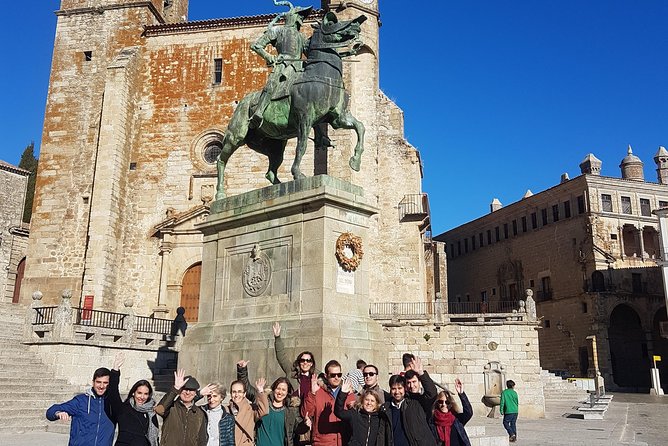
After the castle and church, the route returns to the square and its surrounding palaces. The listed visit includes about 20 minutes in Plaza Mayor, but the square also anchors several separate stops, so you will encounter its buildings more than once as the guide builds the story.
The Palacio del Marqués de la Conquista is a Plateresque palace in the square. Its ornate style reflects the confidence of a family with wealth and status. The palace is not merely a handsome address. It helps explain how overseas fortunes and local prestige appeared in stone.
The Palacio de San Carlos brings a later architectural note, with classicist design from the 16th and 17th centuries. Its more restrained character gives you a useful contrast with the decorative Plateresque work nearby.
The Palacio de Orellanas-Pizarro is identified as the Plateresque palace of the first corregidor of Cuzco. That connection makes the Discoverers theme more precise. The route is not simply about famous names. It shows how service in the Americas connected back to buildings, families, and public life in Trujillo.
These stops are short, generally around 10 minutes each. That works well for a first visit because you keep moving and see a broad range of buildings. If you are an architecture specialist, you may want extra time afterward to return to the facades and examine details at your own pace.
Same valley, a completely different kind of day:
- Piramids of Tucume Tour, Sican Museum and Lambayeque city tour
★ 5.0 · 30 reviews - Pyramids of the Sun and the Moon, Huanchaco and Chan Chan
★ 4.8 · 11 reviews - Trujillo Shore Excursion from Salaverry Port
★ 5.0 · 9 reviews - Pyramids of the Sun and the Moon, Huanchaco and Chan Chan
★ 4.1 · 9 reviews
Pizarro House Museum and the human side of the story
The Pizarro House Museum is listed as a 15-minute stop. It recreates the manor house of a late 15th-century Hidalgo, giving you a more domestic setting after the larger public spaces of the plaza and church.
This is a valuable change of scale. Palaces can make history feel remote, while a recreated manor house helps you picture how a lesser noble household might have been arranged. The guide can also connect the building to the family networks that shaped Trujillo and to the city’s American connections.
The route’s Discoverers themes include the Isabel la Católica Route and the Carlos V Route, as well as cinema locations. These themes broaden the experience beyond a single conquistador narrative. You get a route through medieval politics, royal connections, architecture, and the way Trujillo has been used as a historical setting on screen.
Several guide comments specifically praise explanations of the families of the conquistadors and the significance of individual balconies, coats of arms, and images. That is the sort of detail I would pay attention to. It turns a walk through old streets into a lesson in how status was displayed and remembered.
San Martín and the open-air historic center
The Church of San Martín sits in Plaza Mayor and dates from the 14th to the 16th century. The stop is listed at about 10 minutes, but its admission is not included, so you should treat it mainly as an exterior and historical point unless you arrange entry separately.
That small cost distinction is worth noting. The tour includes several key monuments, but not every building you pass is covered by the ticket price. If San Martín is a personal priority, ask about current admission at the meeting point rather than assuming it is part of the included entries.
The broader historic center is the tour’s real setting. The route describes it as both medieval and Renaissance, an open-air museum of palaces, towers, manor houses, churches, and convents. I like this format because the streets themselves do much of the work. You are not confined to one museum room or one monument.
At the same time, an open-air historic center means the weather matters. The tour begins in the morning, but you will be outside for most of the experience. In warmer weather, carry water and protect yourself from the sun. The stone streets can also be tiring if you are not comfortable walking for around two and a half hours.
The guide makes the difference
The strongest part of this experience is the human interpretation. The tour is in Spanish based on the supplied comments, many of which describe guides named Alicia, Ana, José, and Esmeralda. You should not assume a particular guide is guaranteed on your date, but the repeated praise gives you a useful idea of the expected approach.
Alicia is repeatedly described as prepared, warm, and good at explaining the city’s history. Her talks are said to cover art, architecture, economics, biodiversity, and the role of women in the town’s past. That range is important because Trujillo is more than a town of male conquerors and noble families.
Ana is praised for an engaging manner, detailed explanations, and willingness to answer questions. José is described as dynamic and passionate, with a talent for making the history easy to follow. Esmeralda is praised for matching the setting with an enjoyable presentation.
The comments also indicate that some visits run longer than planned when the guide is explaining a point in depth. That can be a benefit if you want substance, but it is another reason not to schedule a train, meal, or separate activity immediately afterward.
Price, group size, and practical value
At $18.54 per person, the price is reasonable for a guided walk of roughly 2 hours 30 minutes that includes daytime entry to the castle, cisterns, and Santa María la Mayor. The value is strongest if you would otherwise pay separately for those monuments or walk through Trujillo without understanding the family and political connections behind the buildings.
A maximum of 35 people keeps the price below that of a private guide, but it also means the experience may feel less personal than a small-group walk. Stay near the guide when entering narrow streets or monument interiors, and ask questions when there is a natural pause.
The mobile ticket is convenient. Confirmation is provided at booking, and the tour starts at 10:30 a.m. in Trujillo, Cáceres. It ends back at the same meeting point, which makes it easy to continue exploring the town, stop for lunch, or return to a favorite palace facade afterward.
Most people can participate, service animals are allowed, and the meeting area is near public transportation. The supplied details do not promise a fully accessible route, so anyone concerned about steep streets, cobbles, or interior access should check before booking.
Free cancellation is available up to 24 hours before the start time for a full refund. Changes or cancellations inside that window are not accepted, and the activity requires a minimum number of participants. If the operator cancels because that minimum is not reached, you are offered another date or experience, or a full refund.
Who will get the most from this Trujillo walk
I would recommend this tour to a first-time visitor who wants a clear introduction before exploring alone. It suits anyone interested in medieval towns, Spanish royal history, architecture, the Discoverers period, or film locations.
It is also a good choice if you prefer stories to silent sightseeing. The guides are praised for explaining why each shield, balcony, image, and building matters, which is exactly the help you need in a town where historic details can blend together.
Families may appreciate the movement between castle, church, square, streets, and manor house. People with a strong interest in architecture may prefer to take the guided tour first, then return independently to study the palaces in greater detail.
I would be more cautious if you want a slow, highly specialized visit to one monument, or if walking uphill on cobbled streets is difficult. The route covers a lot, and its strength is breadth and connection rather than a long examination of any single interior.
Should you book it?
Book this tour if you want Trujillo to make sense quickly. For $18.54, you receive a guided route through the medieval center, entry to the castle and cisterns, Santa María la Mayor, the Pizarro House Museum, and a useful introduction to the palaces around Plaza Mayor.
The best reason to go is not simply the number of stops. It is the way the route joins architecture with the people behind it, including the noble families, royal links, religious institutions, and American connections that shaped Trujillo.
Skip it only if you already know the town well, need a private guide, or want to spend most of your time inside one monument. For most first visits, this is a strong-value morning walk and a practical way to meet Trujillo before setting off on your own.
FAQ
Where does the Trujillo guided tour start?
The tour starts in Trujillo, Cáceres, Spain, at Plaza Mayor. The activity ends back at the same meeting point.
What time does the tour begin?
The scheduled start time is 10:30 a.m.
How long does the experience last?
The advertised duration is approximately 2 hours 30 minutes. Some guided visits may last longer, so leave extra time afterward.
Is entry to Trujillo Castle included?
Yes. Daytime visits include entry to the Castillo de Trujillo, or Alcazaba, and its cisterns.
Is Santa María la Mayor included?
Yes, Santa María la Mayor is included in the daytime guided visit. Monument tickets are not included for visits beginning after 8 p.m.
Is entry to San Martín included?
No. Admission to Iglesia de San Martín is not included.
How many people can join the tour?
The activity has a maximum group size of 35 travelers.
Can I cancel for a full refund?
Yes. You can cancel at least 24 hours before the experience begins for a full refund. Cancellations or changes made less than 24 hours before the start time are not accepted.
Just added around Trujillo
- Trujillo Shore Excursion from Salaverry Port★ 5.0 · 9 reviews
- Guided Tours Trujillo Essential★ 5.0 · 5 reviews
- Guided Walking Tour in Trujillo Through the Centuries★ 4.5 · 8 reviews
- Piramids of Tucume Tour, Sican Museum and Lambayeque city tour★ 5.0 · 30 reviews
- Shore Excursion from Salaverry port★ 4.5 · 8 reviews
- Pyramids of the Sun and the Moon, Huanchaco and Chan Chan★ 4.1 · 9 reviews
- Pyramids of the Sun and the Moon, Huanchaco and Chan Chan★ 4.8 · 11 reviews
- From Trujillo: Temple of the Moon and Sun and Chan Chan★ 3.3 · 5 reviews
Trujillo Tours, compared.
Guided Tour of Historic and Monumental Trujillo
Read our review →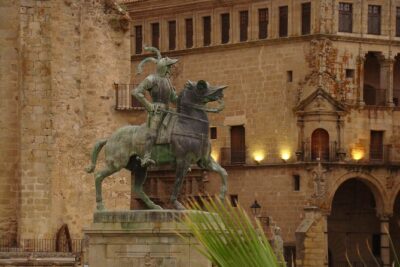
Guided tour in Trujillo at Sunset “El Collector de Atardeceres”
Read our review →
Full Day Tour Huacas, Chan Chan & Huanchaco – Trujillo
Read our review →
Piramids of Tucume Tour, Sican Museum and Lambayeque city tour
Read our review →
Pyramids of the Sun and the Moon, Huanchaco and Chan Chan
Read our review →Pyramids of the Sun and the Moon, Huanchaco and Chan Chan
Read our review →
Browse the lists this tour appears in